
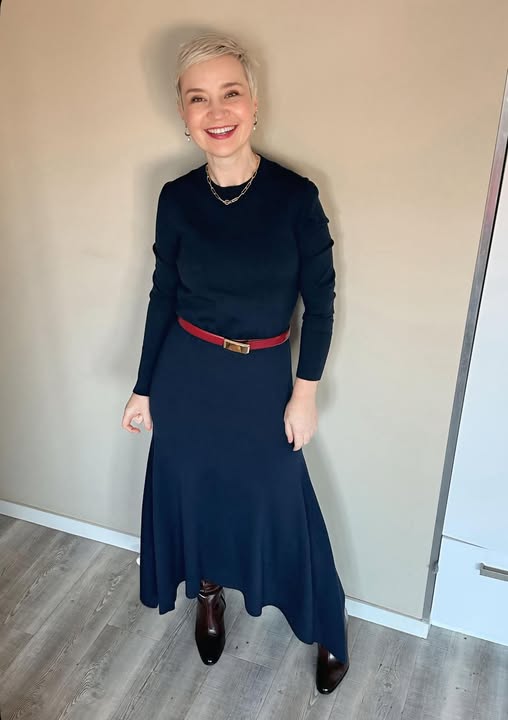
A friend asked me what coat I am choosing to wear this year. She gave me a writing assignment, and that brought, of course, an avalanche of memories and associations.
I asked myself where my passion for fashion comes from. The first image that came to mind was my mother, who always dressed beautifully, in carefully chosen clothes, fine fabrics and textures. I still see her with her long, intensely black hair, glossy and perfectly straight, like in those keratin treatment commercials.
Among other things, in her wardrobe there was an emerald green voile robe, with feathers at the sleeves. I knew it by heart. I knew its smell, its texture, the way it moved when it touched the air. When my mother was not paying attention, I would take it and walk out into the garden wearing it. I would pull it carefully over my shoulders, like a sacred object, and from that moment on the world would change.
The garden was no longer a garden. It was an enchanted land. Trees became gates, bushes hid dragons, and I was no longer the child who had to be careful. I was a fairy. I had magical powers, a mission, a purpose that did not need to be explained to anyone. The robe floated behind me like proof that I belonged to a secret world where I was protected.
Then I think of Coca and her daughters. The house of feminine power. A mother of no less than five girls, and the youngest, Florina, was my best friend. Coca gave me access to the world of fashion. She could create it through magic, with her chalk-covered hands and a clattering sewing machine that forced us to shout our words when it suddenly stopped weaving.
Her daughters were all older than me. They were not just physically beautiful, but confident, walking with determination, laughing loudly. They wore clothes made to measure, clothes that truly seemed to belong to them.
In their room there were fashion magazines. I would flip through them slowly, carefully, afraid not to ruin anything. The women in them seemed to come from another world, and Florina and her sisters were the bridge to that world. They turned dreams into something accessible. They talked about clothes, about cuts, about what would suit them, as if the future were something you could choose.
When she sewed for her daughters, Coca often made something for me too. She would take my measurements seriously, ask me what color I liked, how I wanted it to look. For the first time, my body was asked what it wanted. For the first time, I was not wearing only what was available, but something made and imagined just for me. She had the gift of adding a personal detail, so that even if the clothes followed the same pattern, they carried something of us inside them.
I remember leaving their house, the house of those beautiful and powerful women, with my garment carefully folded like something precious. Whenever I wore it, a blouse with bell sleeves or a dress with thin straps, I felt special, finally seen.
Years later, when playtime ended, Coca and her daughters remained far away, the green robe became just a memory, but I kept that feeling inside me. That there is a place where I can be whole. That femininity is not dangerous. That beauty is not frivolous. That dressing myself, imagining myself, dreaming myself in a certain way is a form of survival.
Maybe that is why, whenever life tightened too hard around me, I instinctively reached for clothes. For textures, for colors, for the gesture of dressing as if I deserved it. Maybe that is why I write now, because writing is also a way of sewing. From fragments of memory, from scattered scenes, from a green robe still fluttering in a garden that has not completely disappeared.
This year, when I decided to choose a new coat, I treated it like a choice that comes late, after too many clothes worn out of duty, out of adaptation, out of the need to be easy to carry. After clothes that helped me survive but quietly made me smaller.
I think of the green robe in the garden and I know the coat now is not that one. It is no longer play, no longer magic, no longer imaginary protection. It no longer floats behind me like a promise that someone will come to save me.
I stand in front of the mirror and take my measurements with an attention that is no longer shy. For the first time, I look at my measurements without judging them, without thinking they are too much. I know exactly what I do not want. I do not want clothes that hide me or make me acceptable. I do not want acrylics and polyesters that reconcile me with other people’s expectations and fears.
The coat I choose this year is made of natural fabrics. It is not loose so I can disappear inside it, and not tight to correct me. I am tired of holding my stomach in.
But I do not want something too comfortable either.
My new coat is expensive, the way I like it. It costs me the desire to please, the role of the woman who molds herself, who smooths every wrinkle, who makes room for everyone else, the approval of those who prefer me small, discreet, grateful.
More than that, I want to burn all the clothes that negotiate my presence or make me tolerable in a world uncomfortable with whole women.
The coat I wear this year is not armor, even if I wish it were. It does not protect me from judgment, from looks, from loss. But it outlines my shape exactly as it is. And between us, this year my shape is better than ever. It keeps me standing straight. And that is enough for me now.
This year I wear a coat that does not undress for love.
It does not change for acceptance.
It does not fold small to fit into crowded closets.
I wear it as testimony to what is already inside me.
And I walk into the world this way.