
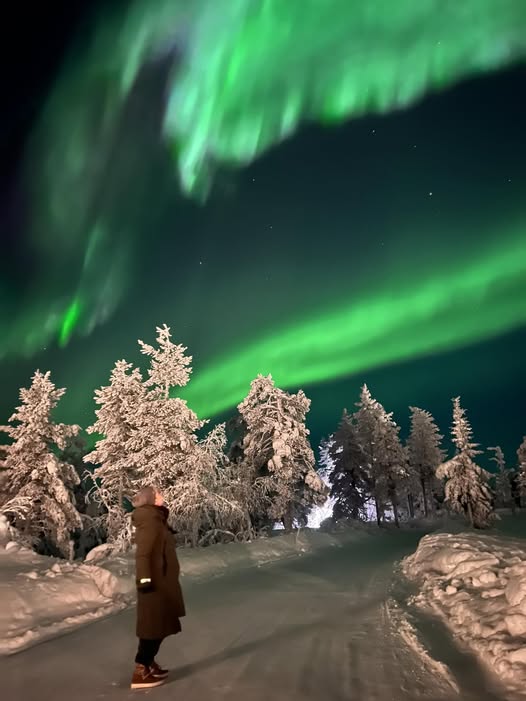
It begins with a mist A gray smoke, almost unnoticeable, stretched above you like a heavenly breath.
You look and wonder: is this it?
All this journey, for a milky stain?
The northern lights do not appear all at once. They are not like fireworks and they do not announce their arrival. They are a shy presence. A diffuse trail, a moving canvas that seems more imagination than reality. If you look at it directly, insistently, it almost withdraws.
And yet you stay.
You stand in the cold. Your fingers go numb. Your breath comes out white. The scarf crystallizes on your face. The sky seems almost empty, only that moving haze, gray-greenish, like a wet curtain.
Then something subtle happens.
The eye begins to learn.
The retina, used to the lights of the city, slowly begins to adapt. Gradually, from that gray without promises, a hint of green slips through. Very fine. Almost a suspicion.
You wonder if you are imagining it.
You keep looking.
And the green gains contour. It lights up on the edges. It undulates. The vapor becomes a wave. The wave becomes a curtain. And from time to time, a pink or violet streak pulses like a vein under the skin of the night.
The sky did not change.
You did.
You stayed long enough to begin to see.
And there is something profound in that. The fact that beauty does not shout. It does not impose itself.
It asks for patience. It asks you to remain.
Then you take a photo.
And on the screen, the colors are more intense than what you perceived with the naked eye. The green is electric. The purple is clear. The contrast is dramatic. The camera captures wavelengths that the human eye barely distinguishes in the darkness. The sensor has no biological limits.
In the photo, the aurora looks more real than reality.
And yet, it is not.
Because the photograph does not capture the cold in your bones.
It does not capture the silence, almost sacred.
It does not capture the long moments in which you stood there waiting for your eye to learn to see.
The aurora is more than colored light in the sky.
It is a patience exercise. A lesson about how extraordinary things often begin like a gray vapor, almost invisible.
And only if you stay long enough, you begin to see the colors.
It resembles inner healing. At the beginning it has nothing spectacular. It is a thick fog, a fatigue that does not leave anymore, a confusion that settles over you like a sky without stars. You search for yourself and find only gray. Numbness. Silences that hurt.
And yet you stay.
You stay in therapy. You stay in your journal. You stay in uncomfortable conversations. You stay in questions without immediate answers. And slowly, something begins to recalibrate inside. The eye of the heart adapts to the darkness it is crossing. You learn to distinguish shades where before you saw only a compact mass of pain.
From numbness emerges a fine vibration of hope.
From shame detaches a thread of gentleness.
From anger, a healthy boundary.
Change does not come like a spectacular explosion. It is a perception that becomes refined.
And there is one detail, almost unfair: sometimes others see the colors before you do. Just as in a photograph the aurora appears more intense than you perceive it, standing in the cold, with eyes still adapting to darkness, in the same way the people around you can see the green already pulsing within you, even if you still call it gray.
They say: “You are calmer.”
“You react differently.”
“There seems to be more light in you.”
You are still in the process. You still see the vapor. Your soul is still trembling.
But from the outside, the image is clearer. More saturated. More coherent.
Healing, like the aurora, does not begin in bright colors. It begins with presence. With patience. With the willingness to remain under a sky that seems empty, until your eyes finally learn to see the light that was already there.